Rainy Day Poems (That Little Kids Will Love)
Rainy afternoon at home? These rainy day poems for kids include classic favorites and simple child-friendly verses, plus easy ideas for turning stormy weather into cozy learning time. Perfect for preschool and early elementary kids during the rainy season. Save this for your next indoor day!
There is something about a rainy day that slows everything down. The pitter patter on the windows. The soft rain falling outside. The way the world feels quieter, almost like it’s asking us to pause.
For little kids especially, a rainy day can feel long. Energy builds up. The house gets loud. You run out of craft ideas before lunch.
That’s where rainy day poems come in.
Reading (or even memorizing!) rainy day poems for kids is such a simple way to turn stormy weather into something cozy, creative, and meaningful. Poetry helps children notice rhythm, sound, and imagery. It builds language skills gently. And it gives you something calm to anchor the day.
Below, you’ll find a mix of classic poets and simple child-friendly poems, plus easy ways to incorporate them into your day with preschoolers and early elementary kids.
Note: Some links may be affiliate links. That means I may make a commission if you use my links to purchase, at no extra added cost to you! I only recommend products that I personally love and believe in. Full disclaimer here.
Why Rainy Day Poems Are Perfect for Kids
Rain connects to emotions in such a natural way.
Even classic poets like Henry Wadsworth Longfellow, Robert Louis Stevenson, and Emily Dickinson wrote about the mood of a rainy world — sometimes about a sad heart, sometimes about hope, sometimes about perseverance.
Poetry about falling rain, a summer shower, or even stormy weather helps kids:
- Notice sounds and patterns
- Practice listening skills
- Explore feelings safely
- Build vocabulary
- Slow their bodies down
And honestly? On a long rainy day, that’s a gift.
Classic Rainy Day Poems (Simplified for Kids)
You don’t need to read the entire original works with little kids. Even short excerpts or adapted lines that feel accessible can pair well with rainy day activities for kids.
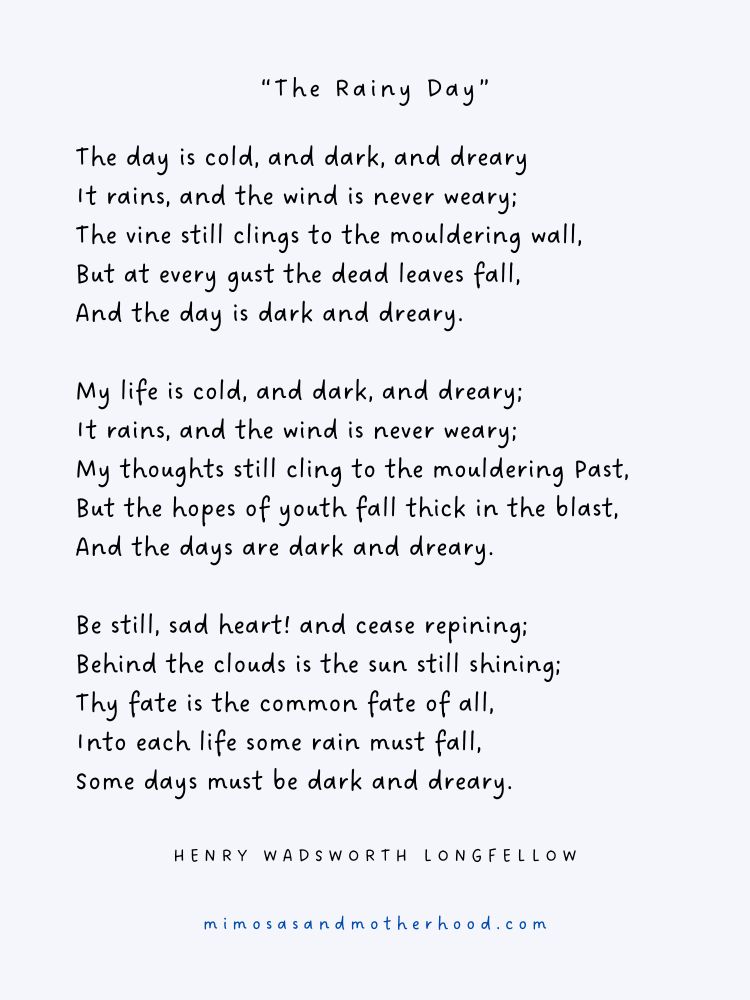
- “The Rainy Day” – Henry Wadsworth Longfellow
Longfellow famously wrote:
The day is cold, and dark, and dreary
It rains, and the wind is never weary;
The vine still clings to the mouldering wall,
But at every gust the dead leaves fall,
And the day is dark and dreary.
My life is cold, and dark, and dreary;
It rains, and the wind is never weary;
My thoughts still cling to the mouldering Past,
But the hopes of youth fall thick in the blast,
And the days are dark and dreary.
Be still, sad heart! and cease repining;
Behind the clouds is the sun still shining;
Thy fate is the common fate of all,
Into each life some rain must fall,
Some days must be dark and dreary.
Even though the full poem reflects on life’s harder moments — “Be still, sad heart, and cease repining; / Behind the clouds is the sun still shining” — it’s a beautiful way to talk with kids about feelings.
Kid connection idea: Ask your child: “What do you think happens after the rain?” (Sunshine. Rainbows. Bright-hued flowers.)
- “Rain” – Robert Louis Stevenson
The rain is raining all around,
It falls on field and tree,
It rains on the umbrellas here,
And on the ships at sea.
Stevenson’s poems often feel playful and visual. This one is made up of one short section, making it perfect for toddlers.
Talk about the friendly shelter of the leaves, the ceaseless dripping, and how rain changes the look of a mountain top or even a mouldering wall.
Kid connection idea: Have them close their eyes and describe what rain sounds like. Is it soft rain? A foaming torrent? A summer shower?
- Emily Dickinson’s Rain Imagery
Emily Dickinson often described nature in tiny, specific details — like a tiny bird fluttering after a storm.
Kid connection idea: After reading a few lines, ask:
“What animals do you think hide during stormy weather?”
“Where would you find shelter — maybe brown caves or under big leaves?”
- Elizabeth Bishop’s “Rain Towards Morning“
The great light cage has broken up in the air,
freeing, I think, about a million birds
whose wild ascending shadows will not be back,
and all the wires come falling down.
No cage, no frightening birds; the rain
is brightening now. The face is pale
that tried the puzzle of their prison
and solved it with an unexpected kiss,
whose freckled unsuspected hands alit.
Poets like Elizabeth Bishop noticed ordinary details, like puddles, reflections, dripping trees. She also wrote the poems “Song for the Rainy Season” and “Sestina” that also feature rain.
Kid connection idea: Put a bowl outside during the rainy season and watch the water collect. Then write one sentence about what you see.
- “Rain” by Edward Thomas
Rain, midnight rain, nothing but the wild rain
On this bleak hut, and solitude, and me
Remembering again that I shall die
And neither hear the rain nor give it thanks
For washing me cleaner than I have been
Since I was born into this solitude.
Blessed are the dead that the rain rains upon:
But here I pray that none whom once I loved
Is dying tonight or lying still awake
Solitary, listening to the rain,
Either in pain or thus in sympathy
Helpless among the living and the dead,
Like a cold water among broken reeds,
Myriads of broken reeds all still and stiff,
Like me who have no love which this wild rain
Has not dissolved except the love of death,
If love it be towards what is perfect and
Cannot, the tempest tells me, disappoint.
In Edward Thomas’s poem about rain, he reflects on the quiet and isolation of a storm. While that version is more reflective and mature, you can simplify the theme: rain makes us pause.
Kid connection idea: Talk about how rainy days are special days to rest, read, and reset.
Original Rainy Day Poems for Kids
Here are a few simple, child-friendly rainy day poems for kids you can use right away:
☔ Pitter Patter
Pitter patter on the pane,
Softly falls the silver rain.
Little boots on a chilly path,
Splashing puddles, giggle-laugh.
🌧 The Rainy World
In a rainy world so gray,
Clouds have come to gently play.
Behind the storm, the sun will stay,
Waiting for a brighter day.
🌈 After the Storm
When falling rain begins to slow,
And tiny streams begin to flow,
Up will rise a rainbow glow,
A bright-hued flower’s gentle show.
🐦 Little Bird
A tiny bird on grim rock’s side,
Waits for clouds to drift and slide.
When soft rain stops its steady song,
She lifts her wings and flies along.
How to Use Rainy Day Poems With Little Kids
Here’s where it gets practical. Poetry doesn’t need to feel formal or serious.
- Make a Cozy Reading Corner: Pull out blankets. Sit by the window. Watch the falling rain. Let your child hear the rhythm of the poem while they feel safe and warm. Rain naturally slows the day. Lean into that.
- Turn It Into a Listening Game: Read a poem once, then ask questions like “What word did you hear twice?” “Did you hear pitter patter?” “Was the rain soft rain or stormy weather?” This builds listening skills without worksheets.
- Act It Out: Have your child act along with the poem! They can pretend to be a tiny bird, tiptoe along a chilly path, stomp like a foaming torrent, curl up like a bright-hued flower etc. Movement helps poetry stick.
- Create Your Own Rain Poem: Even preschoolers can fill in blanks and create their own poems! Start with prompts like “The rain sounds like ________.” “The clouds look like __________.” “I feel __ when it rains.” They can imagine a character dancing in puddles, or a mountain top wrapped in clouds as they create their own poetry. You’d be surprised what they come up with.
- Pair Poems With Nature Observation: If the rain stops (or becomes lighter), step outside. Look at the friendly shelter of the leaves, mud near a mouldering wall, little streams near rocks or a tiny bird shaking off droplets. Rain connects poetry to real life in the most natural way.
Rainy Days Don’t Have to Feel Long
Rainy days can sometimes bring out big feelings in kids. A sad heart, extra energy, maybe even sibling squabbles.
But poetry reminds us, just like Longfellow wrote, that behind the clouds, the sun is still shining.
Stormy weather passes.
Summer showers fade.
Rainy seasons change.
And sometimes, those slow days become the ones we remember most. These simple rainy day poems can help make these days stuck inside more magical.
Rain has inspired poets for centuries, from Henry Wadsworth Longfellow to Emily Dickinson to Robert Louis Stevenson. And on your next rainy afternoon, it might inspire your little one too.
Did you enjoy this article? Use the image below to pin it on Pinterest to help other families find this useful information, too!